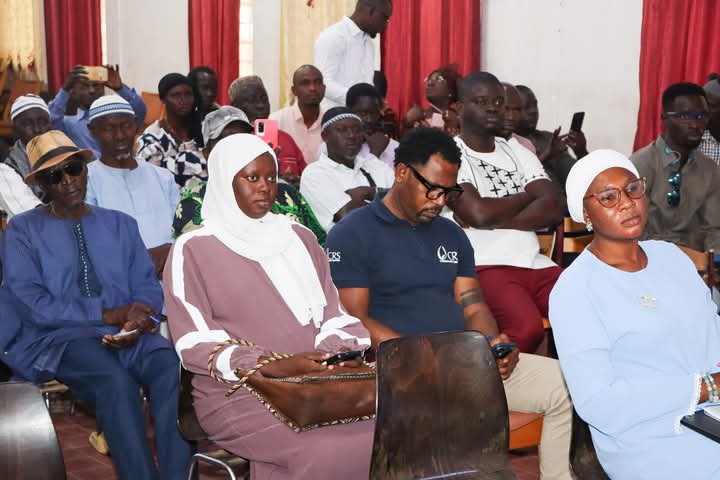
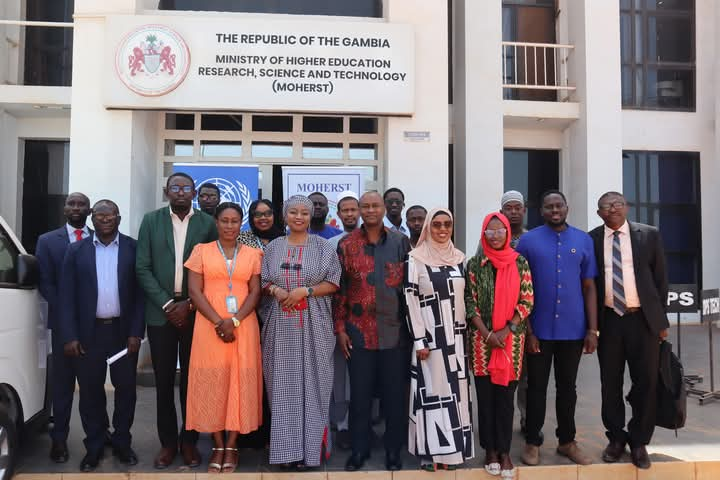
Her Excellency Ambassador Jainaba JAGNE, the Permanent Secretary of the Ministry of Higher Education, Research, Science and Technology (MoHERST) recently presided over the official inauguration of the Technical Working Group (TWG) for the proposed Innovation Ecosystem Mapping.
The event held at the MoHERST Conference Hall in Bijilo marked the establishment of the TWG, a multi-stakeholder team tasked with guiding and overseeing the comprehensive mapping of The Gambia’s innovation ecosystem.
The initiative was organised by MoHERST in collaboration with the United Nations Development Programme (UNDP).
This initiative seeks to generate evidence-based data to address key gaps, enhance collaboration among stakeholders, and provide recommendations and actionable insights to drive innovation-driven development in alignment with national, regional, and global priorities.
In her inaugural speech, Her Excellency, Ambassador. Jainaba JAGNE, Permanent Secretary at the Ministry of Higher Education, revealed that The Gambia’s journey towards sustainable development and global competitiveness rests on the ability to harness innovation as a driving force for growth, inclusivity, and resilience. She noted that the Innovation Ecosystem Mapping Initiative is a groundbreaking effort designed to evaluate and enhance The Gambia’s innovation landscape.
By identifying key stakeholders, resources, gaps, and opportunities, she said the initiative will serve as the foundation for building a cohesive, inclusive ecosystem that supports sustainable development while aligning with international benchmarks such as the Global Innovation Index (GII).
“This is not just about gathering data—it is about identifying strategies to overcome challenges such as urban-rural disparities, fragmented resources, and limited access to tools needed to innovate. By addressing these gaps, we aim to unlock The Gambia’s vast potential for creativity, entrepreneurship, and scientific progress,” she stated.
She added that the Technical Working Group will be central to the success of the initiative which comprised of representatives from key institutions, including MoHERST, UNDP, GBoS, and the Ministry of Justice, among others, adding that the technical working group brings together a wealth of expertise to ensure an effective and impactful process.
Ambassador JAGNE said that TWG’s mandate includes aligning the mapping process with national development priorities and global standards, to oversee and validate tools, methodologies, and findings to guarantee relevance and accuracy and foster collaboration among stakeholders and ensure inclusivity at every step of the process.
Speaking on behalf of the Resident Coordinator of the United Nation Development Programme (UNDP) Samba B. Jallow said that part of the role of the Technical Working Group is to outline the TWG’s mandate to provide strategic oversight, validate methodologies and findings, and ensure that the mapping process is inclusive, evidence-based, and actionable.
He said that the TWG responsibility is to address challenges encountered during the process, to emphasize that the TWG is integral to fostering collaboration among stakeholders and aligning efforts with national and international development frameworks and to encourage members to actively contribute their expertise, insights, and networks to ensure the mapping exercise addresses the unique challenges and opportunities within The Gambia’s innovation ecosystem.
He assured that the UNDP will provide support in aligning the mapping process with global standards and ensuring actionable outcomes, to highlight UNDP’s broader commitment to fostering innovation as a driver of sustainable development, particularly in empowering youth, women, and marginalised communities, among others.
The event was moderated by Mucktarr M.Y. Darboe, Deputy Permanent Secretary Technical at the Ministry of Higher Education, Research, Science and Technology, who did a brief presentation on the TOR of the Technical Working Group.