
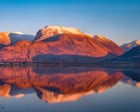
The writer and climber brings colour and carnival to his account of a country and people shaped by its mountains
It comes as a shock to learn that Britain’s uplands were not always rocky, covered with coarse grass and suitable only for sheep. About 54,000 years ago – a mere blink in geological time – this island’s high places were teeming with nature. Lushly forested peaks, crags and gorges were home to megafauna including mammoth, woolly rhinoceros and giant elk. The one sour note in this elevated Garden of Eden was the carnivorous cave lions and sabre-tooth cats who prowled the browse looking for a meaty dinner.
Ed Douglas’s achievement in this excellent book is to return a proper sense of colour and even carnival to Britain’s high places. His first job, though, is to define his terms. In 1936, the celebrated US geographer Roderick Peattie declared that what made a mountain was not its elevation so much as its capacity to “enter into the imagination of the people who lived in [its] shadows”. But by the 1990s, the United Nations, newly tasked with protecting the world’s high places from environmental and economic decline, insisted on getting out its tape measure and statistical charts and coming up with some universal criteria.