
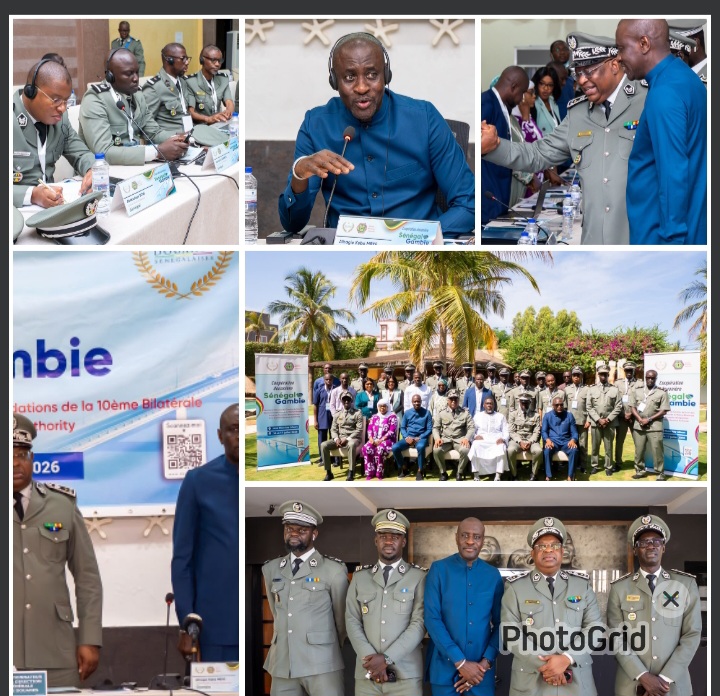
The Gambia Revenue Authority (GRA) and the Senegalese Customs Administration have reached a landmark agreement on a three-month implementation roadmap aimed at eliminating major customs bottlenecks, strengthening border security and facilitating the seamless movement of goods and people between the two countries.
The breakthrough was reached during the Second Monitoring Committee Meeting held on 16–17 July 2026 at the Rhino Hotel, Resort and Spa in Saly, Mbour, where senior customs officials from both countries resolved all outstanding operational issues and endorsed concrete timelines for implementation.
The agreement, signed on behalf of the two Directors General of Customs, represents one of the most significant bilateral customs cooperation initiatives in recent years, following commitments made by Presidents Adama Barrow of The Gambia and Bassirou Diomaye Faye of Senegal to improve cross-border trade and security.
Among the key decisions reached at the two-day meeting is the installation of the GAINDE Customs System at all major border posts, including Karang, Keur Ayib and Selety, within the next three months.
The two administrations also agreed to deploy the SIGMAT electronic transit system, which will enable real-time monitoring of goods in transit, improve transparency and reduce delays along the transport corridor.
A major outcome of the meeting was the decision to completely eliminate the double escorting of transit goods along the Wellingara Corridor, a long-standing concern raised by transporters and traders due to the additional costs and delays it created.
Officials further resolved to abolish the use of transit agents at border crossings by introducing the Single Administrative Document (SAD) for transit goods, a move expected to simplify customs procedures and enhance efficiency.
To strengthen operational cooperation, the two customs administrations agreed to conduct joint border operations every three months, while committing to exchange customs data electronically through an Application Programming Interface (API) once the GAINDE system becomes fully operational.
The meeting also endorsed the reactivation of EnCen, a platform dedicated to intelligence and information sharing between the two customs services to combat smuggling, fraud and other cross-border crimes.
Delivering remarks on behalf of the Commissioner General of the Gambia Revenue Authority, Alhagie K. Mbye, Commissioner of Customs, described the meeting as a critical milestone in implementing the directives of the two Heads of State.
“It is my honour and privilege to welcome you to this second Monitoring Committee Meeting between our two neighbouring countries,” he said.
He noted that the meeting followed the commitment made by the two Presidents and the Directors General of Customs to work jointly in addressing challenges along their common border.
“Their shared vision calls upon our institutions to strengthen collaboration, resolve outstanding border issues through dialogue, and create an environment that promotes secure borders, facilitates legitimate trade, and supports the free movement of people and goods in accordance with our respective laws,” he stated.
Commissioner Mbye recalled that GRA Commissioner General Yankuba Darboe, during the recent Presidential Council meeting in Dakar, stressed the need for both customs administrations to decisively remove all customs-related impediments along their shared corridors.
“The time has come for our two Customs administrations to act decisively to bring to rest all Customs-related impediments along our corridors,” he said, adding that this could only be achieved through concrete action, closer cooperation and clear implementation measures.
He emphasised that customs administrations have a central role in translating the political commitment of the two Heads of State into practical and measurable results through coordinated border management, intelligence sharing and regular engagement.
Expressing confidence in the outcome of the meeting, Mbye said the discussions would produce practical solutions that would strengthen bilateral cooperation while improving border efficiency, trade facilitation and regional economic integration.
The resolutions adopted during the meeting will now be implemented over the next three months, with both customs administrations expected to monitor progress against the agreed roadmap before their next review meeting.
By Abdoulie Nyokeh