
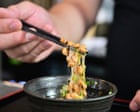
Comprised of smelly soya beans held together by strands of mucus, the ancient dish is appearing in health food shops across the world
It is smelly, slimy and contains bacteria – and a sizeable number of Japanese wouldn’t touch it with a pair of barge pole-length chopsticks. But after centuries as a breakfast food for Japanese diners with nerves of steel, natto is emerging as a global superfood to rival kimchi, kombucha and kefir.
Its exact origins are unknown. Some believe it was introduced to Japan from China by Buddhist monks during the Yayoi period (300BC-AD300), before becoming a staple among rural communities during the Edo period (1603-1868).