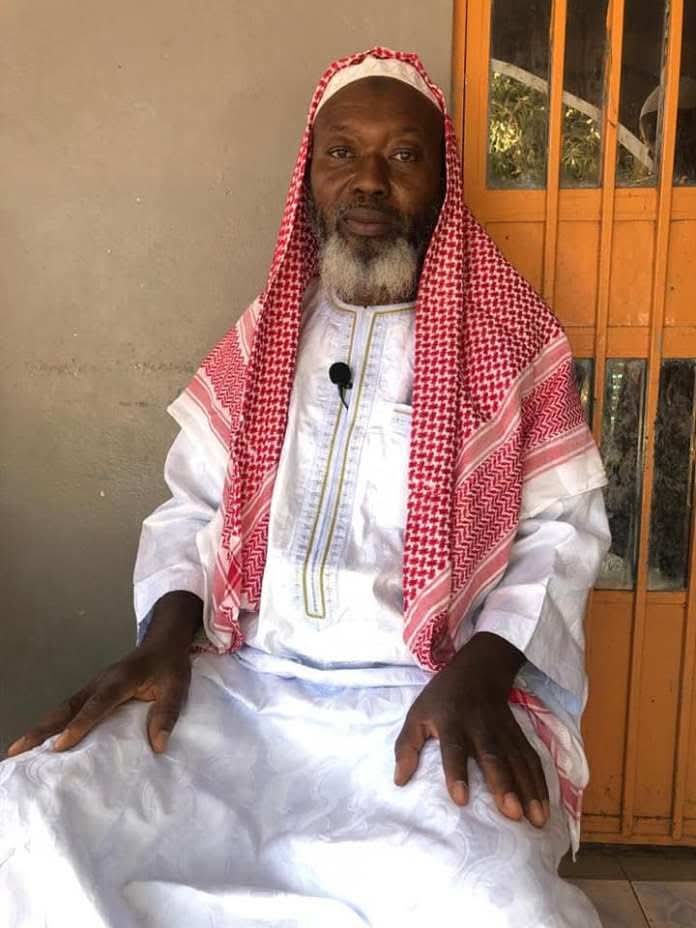
Imam Abdoulie Fatty’s dramatic defiance before the Supreme Court raises a deeper question: why was this courage absent in 2015 when Yahya Jammeh banned FGM without challenge?
“I’d rather die than follow you and leave God.” With these dramatic words before the Supreme Court, Imam Abdoulie Fatty presented himself as a man of unshakeable conviction, a religious figure prepared to sacrifice his life rather than compromise divine instruction.
It was a declaration delivered with fire, certainty, and theatrical courage. Yet this very courage forces the nation to confront an uncomfortable but necessary question: Where was this conviction in 2015, when Yahya Jammeh banned FGM with a single decree?
This is not a theological question. It is a question of consistency, timing, and moral clarity. In 2015, when Jammeh outlawed FGM and demanded religious justification for his decision, no public record shows Imam Fatty challenging him, correcting him, or warning him that he was violating God’s law.
The same man who now insists he would “rather die” than follow a human law over divine instruction did not express such defiance when the most powerful man in the country, a ruler known for punishing dissent, imposed the ban.
His silence in 2015 stands in stark contrast to the thunderous declarations he now makes in a democratic courtroom.
The Women’s (Amendment) Act of 2015 criminalised all forms of FGM in The Gambia. It was introduced under Yahya Jammeh, who announced the ban publicly and forcefully. Religious leaders were present. The nation watched. Yet Imam Fatty did not challenge the decree, did not question its religious basis, and did not warn that the ban contradicted prophetic teachings.
His silence was not unique — many feared Jammeh’s wrath, but it became significant when placed beside his current rhetoric, which frames FGM as a religious obligation and the ban as an affront to divine law.
With the fall of the dictatorship and the restoration of democratic freedoms, Imam Fatty has re-emerged as one of the most vocal opponents of the FGM ban. His activism intensified in 2024 and 2025, marked by public mobilisation, courtroom defiance, and a sweeping dismissal of medical evidence.
He has paid fines for convicted cutters, encouraged communities to resist the law, and insisted that the practice carries no harm. In the Supreme Court, he declared that he would choose God over the law, insisting that he would rather die than obey a statute he believes contradicts prophetic instruction. It is a powerful line, but its power is weakened by its timing. The courage that was absent under dictatorship has reappeared under democracy, where speech is protected, and dissent is safe.
During his testimony, Imam Fatty argued that Gambia practices a mild form of circumcision, that only a few deaths have been linked to the practice, and that the Prophet endorsed a small cut. He insisted that the practice promotes cleanliness and controls desire, and he dismissed medical reports as exaggerated or financially motivated.
Under cross-examination, he acknowledged that FGM is not in the Qur’an, that some hadiths supporting it are weak, that Islam is practiced elsewhere without it, and that he is not a medical doctor. He confirmed that all sixteen of his daughters were circumcised and described deaths from FGM as “God’s destiny.”
These statements now form part of the national record and will shape the public’s understanding of the debate.
The broader context cannot be ignored. The Gambia has one of the highest FGM prevalence rates in the world, with approximately 75 percent of women aged 15 to 49 having undergone the practice.
Medical evidence links FGM to severe pain, bleeding, infections, childbirth complications, and death. A reported infant death in 2025 underscores the ongoing danger.
The 2015 ban was not symbolic; it was a life-saving intervention, enacted to protect women and girls from preventable harm.
The debate now unfolding is not simply about FGM. It is about public memory and selective courage. It is about whether Gambians will allow religious authority to be exercised differently under dictatorship and democracy.
It is about whether leaders should speak only when it is safe or when it is necessary. Imam Fatty is free to express his views, which is the beauty of the democracy Gambians fought for, but the public is equally free to examine the record.
Silence under Jammeh and defiance under democracy are not the same thing. Deferring to absolute power and boldness toward elected leaders reveals a contradiction that the nation must confront honestly.
The Supreme Court will ultimately decide the constitutionality of the FGM ban. But the court of public conscience must decide something deeper: the meaning of courage in a democracy.
True courage is not loudness in freedom. True courage is truth in danger. And on that measure, Gambians must decide what the record shows.





Yo, need a quick agbong88login. I heard this gives direct access. Is it reliable? Tired of the endless redirects. Feedback, anyone? Have a glance: agbong88login
Hey guys, just tried out fortunegodsvn. Seeing some decent action there! Definitely worth checking out if you’re looking for something new to play. Link is fortunegodsvn