By Madiba Singhateh
The African Confederation of Professional Small-Scale Fisheries Organisations (CAOPA) has brought together small-scale fisheries organisations from The Gambia, Senegal and Guinea-Bissau to strengthen cooperation on the sustainable management of shared fish stocks. The aim is to establish a joint commission for sustainable fisheries.
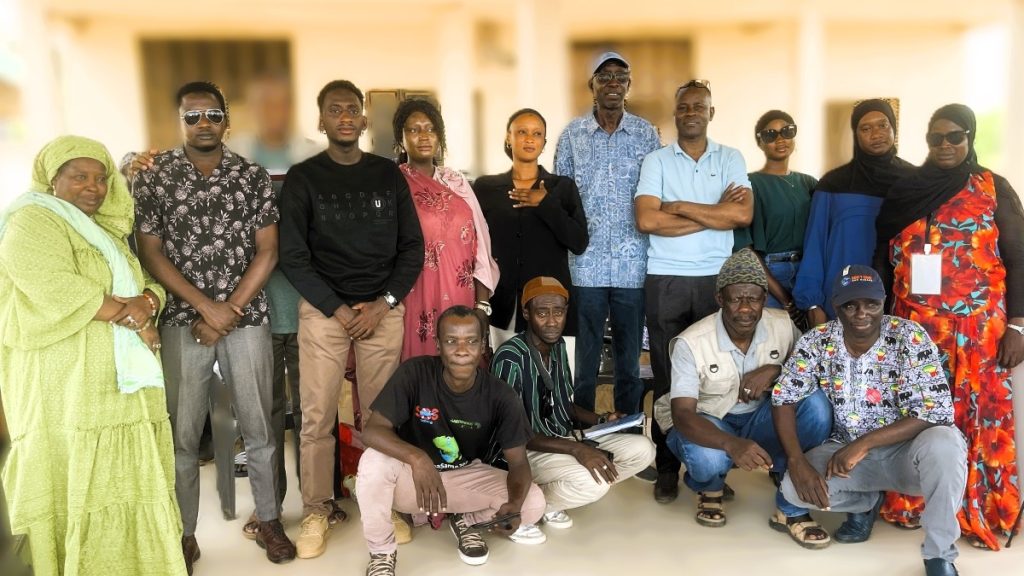
CAOPA, which represents men and women working in small-scale marine and inland fisheries across 29 African countries, organised a series of meetings from 11 to 17 July in Ziguinchor, Senegal; Gunjur and Brufut, The Gambia; and Guinea-Bissau.
The organisation, founded in 2010 in Banjul, stated that this initiative aimed to establish a framework for shared governance of the fisheries resources common to the three neighbouring countries.
These meetings brought together fishermen, fish wholesalers, fish processors and representatives of fishermen’s organisations to discuss the sustainable management of small pelagic fish, conflict prevention and closer cooperation between fishing communities.
The tripartite commission will bring together the National Inter-professional Council for Artisanal Fisheries of Senegal (CONIPAS), the National Association of Artisanal Fisheries Operators (NAFFO) of The Gambia and the National Network of Women in Artisanal Fisheries (RENAMUP) of Guinea-Bissau.
A key proposal is to establish joint committees on small-scale fisheries between: (NAFFO) The Gambia and (CONIPAS) Senegal, and
(CONIPAS) Senegal and (RENAMUP) Guinea-Bissau. These three organisations will work under the auspices of CAOPA to advocate for the proper implementation of fisheries agreements between the countries, address the challenges faced by small-scale fishing communities and strengthen the sustainable management of shared fish stocks.
Speaking to journalists in Brufut on 14 July, CAOPA’s Secretary-General, Dawda Saine, said that the commission would be able to strengthen cooperation between artisanal fishing organisations in the three countries.
“The main objective of this meeting is to establish a form of sub-regional collaboration between organisations in Senegal, Guinea-Bissau and The Gambia,” he said.
He explained that CAOPA was working with the governments to coordinate the activities of small-scale fishermen through national umbrella organisations.
“In Senegal, there is CONIPAS; in Guinea-Bissau, RENAMUP; and in The Gambia, NAFFO,” he explained.
“This is also an umbrella organisation that coordinates small-scale fishing activities.”
Mr Saine indicated that the commission seeks to promote what he described as the “effective participation” of fishing communities in the decision-making process.
“Often, the reason we want to establish this structure is to be able to participate, and to participate effectively.
“Most of the time, when we talk about participation, people will say to you: ‘Well, you were invited to meetings, you signed the attendance register and the allowance register, so we consider that you’ve participated.’ That’s not what we’re talking about here. We’re talking about effective participation where we can take the initiative. ”
He added that the commission is also in line with the United Nations Sustainable Development Goals, particularly those that encourage partnerships.
“In this regard, if fishermen in Senegal implement measures that The Gambia does not apply, even though they share the same border, this is of inestimable value,” he said.
“Because, as you know, irresponsible fishing, wherever it takes place, poses a threat to sustainable management everywhere else. We share the same border.”
“If you protect your resources, or protect them sustainably, and Senegal does not do the same, this means that any irresponsible activity carried out in Senegal has an impact on the responsible activity carried out in The Gambia. That is why it is important to have this kind of joint commission,” he explained.
He added that the commission also forms part of the legal framework promoting collaborative fisheries management. Mr Saine indicated that one of the key priorities would be to tackle pricing issues in the fisheries sector and to combat illegal, unreported and unregulated fishing.
“We must examine how we are going to resolve the pricing issues in this sector. The sector is facing illegal, unreported and unregulated fishing. And this stems from human behaviour,” he said.
“For if we look at the history of fishing from its very beginnings, we see that the systems have changed time and time again. Protocols have changed, the convention has been abandoned, but the problem persists. When I speak of this problem, I mean that the destruction continues.”
“This therefore shows that the change we need is no longer a change of system, a change of policy or a change of legislation, but a change in human behaviour. It is human behaviour that is at the root of the problem. It is this that is destroying the resources. ”
The CAOPA chairman, Gaoussou Gueye, said that the commission would help fishermen’s organisations in the three countries to work together to protect the interests of small-scale fishermen.
“The government has signed agreements, but the question is whether these agreements are in the interests of small-scale fishermen,” he said.
Mr Gueye added that associations representing small-scale fishermen should work together to examine whether regional agreements and fisheries measures benefit fishing communities. The meeting in The Gambia also brought together journalists for a session focusing on the role of the media in raising awareness of the challenges facing small-scale fisheries and the importance of sustainable fisheries management.
Gambian journalists and presenters learnt about the experience of the Association of Fisheries Communicators from Community and Generalist Radio Stations in Senegal (ACPRCG), presented by Omar Diaw, president of the ACPRCG. A similar initiative is being considered by CAOPA in The Gambia to better inform, raise awareness amongst and support fishing communities.
You need to login to view and post FB Comments!