
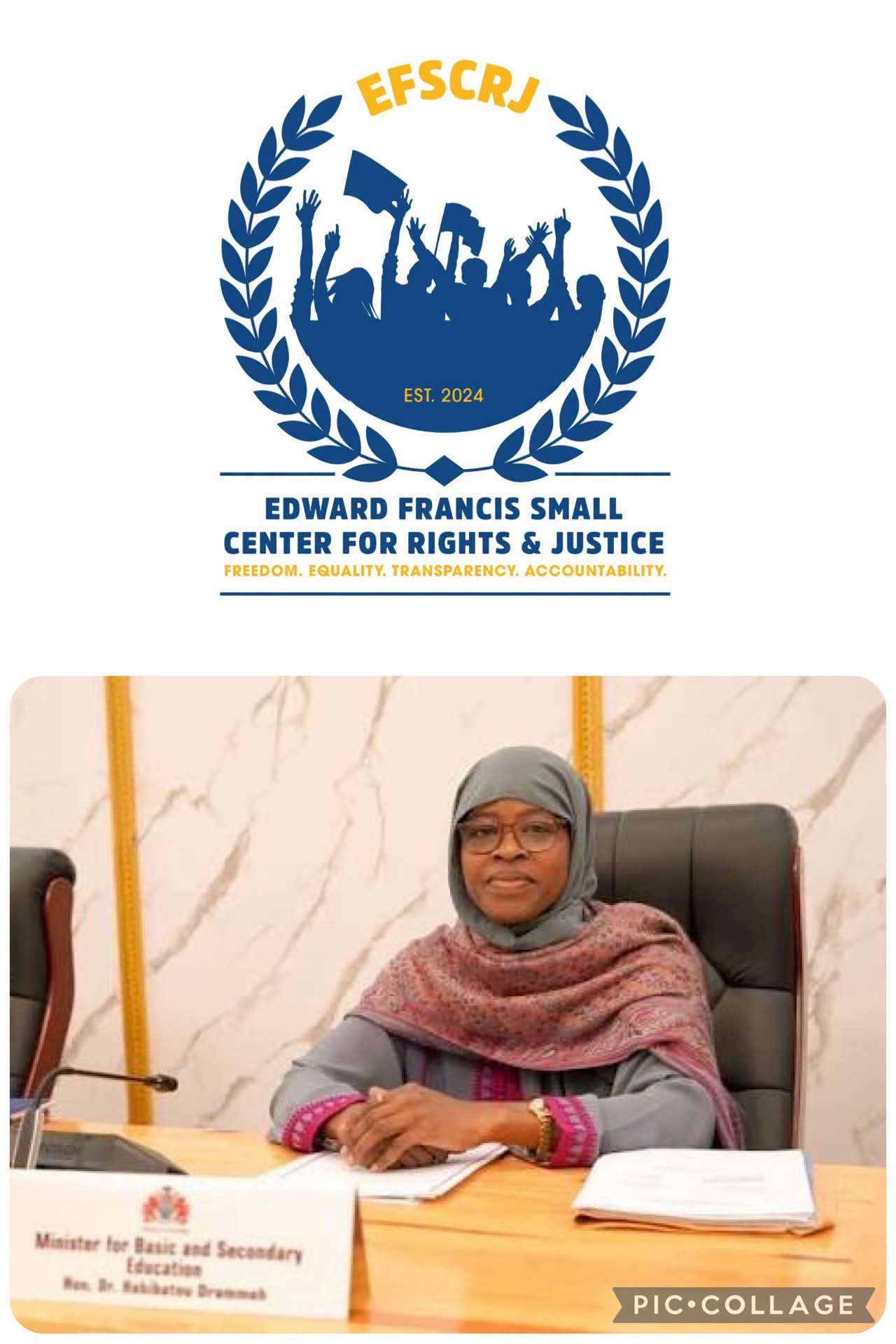
Government Must Urgently Rescue The Gambia’s Education System
The Edward Francis Small Centre for Rights and Justice notes with grave concern the 2026 West African Senior School Certificate Examination results released by the Ministry of Basic and Secondary Education. While we recognise the efforts of students, teachers, parents and schools, the results reveal a national education system in deep crisis, requiring urgent, transparent, and decisive intervention.
According to the Ministry, only 5,171 candidates, representing 26.17%, obtained a credit in English Language, while merely 1,814 candidates, or 9.18%, secured a credit in Mathematics. More alarming is that only 1,410 candidates, i.e., 7.13% of all processed candidates, obtained five or more credits, including English and Mathematics, which constitutes the principal qualification benchmark for direct entry into many higher education programs.
This means that more than 92% of candidates did not meet this fundamental benchmark after twelve years of formal education. Furthermore, 7,212 candidates obtained no credit in any subject. Within this group, 1,496 candidates sat all their examination papers but received F9 grades in every subject. These figures cannot be normalized, minimized, or presented as evidence of a “structurally sound” education system. They constitute a national education emergency.
The increase in candidates obtaining five or more credits, from 19.1% in 2025 to 22.6% in 2026, is welcome. However, this figure falls sharply to 7.2% when English and Mathematics are included. Mathematics performance is particularly catastrophic, as more than nine out of every ten candidates failed to obtain a credit. Similarly, almost three-quarters did not secure a credit in English. These outcomes expose severe weaknesses in foundational literacy and numeracy, teacher preparation and deployment, curriculum delivery, instructional time, school leadership, learning materials, and educational supervision.
EFSCRJ also notes that 1,958 candidates within the zero-credit category were affected by partial or complete examination absenteeism, including 199 candidates who missed all their papers. The Ministry must investigate the reasons behind this alarming situation. Poverty, transport challenges, unpaid educational costs, child labour, early marriage, teenage pregnancy, illness, migration and inadequate parental or institutional support may be contributing factors. Every absent candidate represents a young person whom the education system may have failed to protect, retain, and support.
While the performance of individual schools and specialized subjects deserves recognition, success in selected subjects involving relatively small numbers of candidates cannot conceal the overall national crisis. A 56.13% credit rate in Chemistry and 75.43% in Auto Mechanics are encouraging, but only 2,015 and 464 candidates respectively were registered for these subjects. Meanwhile, nearly 20,000 candidates participated nationally. Similarly, the 24.59% credit rate in ICT raises serious questions about whether technical education can reasonably be described as thriving.
The huge disparity between schools is equally disturbing. While Mansa Colley Bojang Senior Secondary School achieved a 97.04% university-entry qualification rate, the national average was only 7.13%. Such a wide gap suggests that a child’s educational prospects may depend heavily on the school attended, place of residence, family income and availability of qualified teachers and learning resources. The right to education demands not merely access to a classroom, but equal access to quality education capable of producing meaningful learning outcomes.
The Ministry’s celebration of female participation also requires deeper examination. Females constituted 63.62% of processed candidates and 57.66% of those meeting the higher education benchmark. However, based on the Ministry’s figures, approximately 6.5% of female candidates obtained five credits including English and Mathematics, compared with about 8.3% of male candidates. Female enrolment must therefore be matched by deliberate measures to ensure equal achievement, retention, and progression.
In light of these findings, EFSCRJ calls on the Government to:
1. Declare the current learning crisis a national priority and establish an adequately funded, time-bound National Education Rescue Program.
2. Commission an independent diagnostic review of the education system, focusing particularly on the persistent failure in English Language and Mathematics.
3. Publish the complete performance of all 151 participating schools, disaggregated by school, region, gender, disability, ownership, and other relevant factors.
4. Develop mandatory improvement plans for every underperforming school, accompanied by targeted resources, teacher mentoring, and regular monitoring.
5. Conduct a comprehensive national teacher audit covering qualifications, subject specialization, deployment, attendance, workload, and professional development.
6. Investigate examination absenteeism and establish early-warning and support systems for students at risk of dropping out or missing examinations.
7. Strengthen school inspection, leadership accountability, teacher support, and community participation in educational governance.
8. Review the availability and quality of textbooks, laboratories, libraries, digital facilities and other teaching and learning resources across urban and rural schools.
9. Establish measurable annual national performance targets and publish transparent progress reports showing the actions taken, resources invested and results achieved.
The 2026 WASSCE results are not merely examination statistics. They concern the future of thousands of young Gambians and the country’s prospects for development, employment, productivity, democratic citizenship, and social stability. Education is a fundamental human right and an indispensable public good. The Government has a duty to ensure that every child receives an education that develops their abilities and prepares them to participate meaningfully in society.
EFSCRJ therefore urges the Government to abandon complacency and confront the scale of this crisis honestly. Selective success stories and reassuring language cannot substitute for learning, competence, and equal opportunity. Every year of inaction condemns another generation of Gambian children to years of schooling without meaningful education.
2026 – The Year of Empowerment: Empowered Citizens. Accountable Leadership